


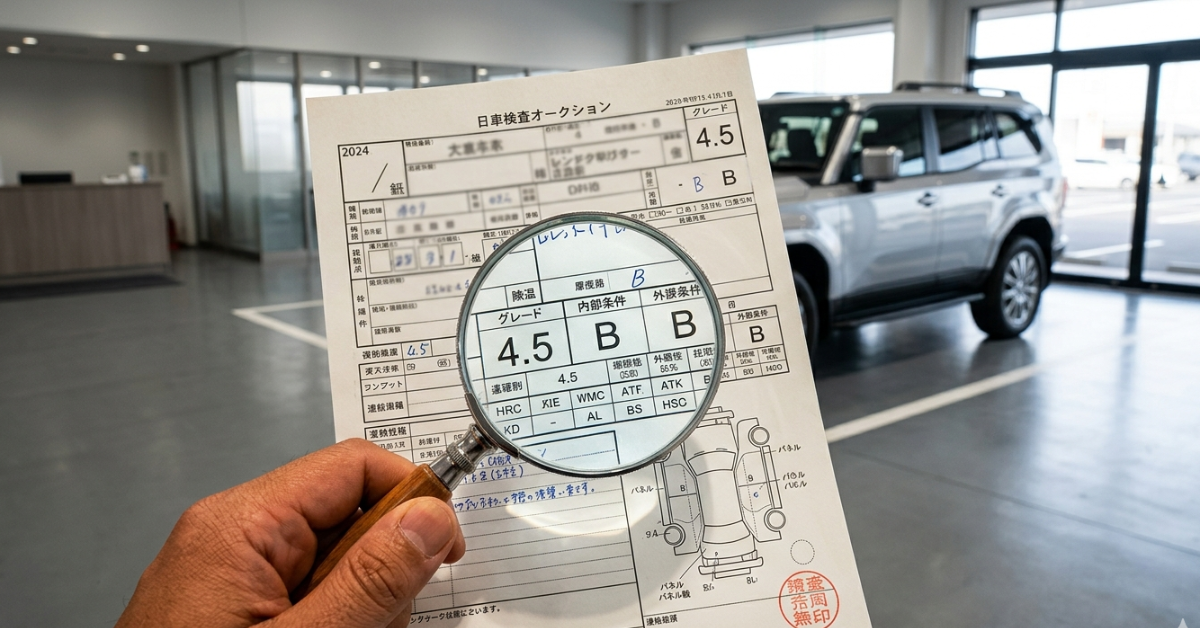
How to translate a Japanese auction sheet is the single most important skill you can learn before bidding on your dream JDM vehicle.
You see Grade 4 on an auction sheet and think, ” Perfect car, right? Not always. A Grade 4 from one auction house might mean something entirely different from another.
Furthermore, that small triangle (Δ) next to the fender on the diagram could mean the car was involved in a major accident.
Therefore, relying on surface-level impressions is a dangerous game that often leads to “buyer’s remorse”.
This guide teaches you how to translate an auction sheet correctly, so you never mistake a lemon for a gem.
For more context on the bidding process, you can read about how Japanese auctions work.
What Is an Auction Sheet?
An auction sheet is an official condition report issued by Japanese auction houses. These documents are created by professional third-party inspectors whose job is to provide an unbiased assessment of the vehicle.
Every sheet includes vital data:
- the overall grade,
- mileage,
- presence of rust,
- repair history, and
- detailed interior/exterior condition scores.
However, it is crucial to understand that not all sheets are created equal.
Different auction sites, such as USS, AUCNET, TAA, and JU, utilise slightly different grading scales. For example, a Grade 4 at a USS auction may be strictly evaluated, whereas a Grade 4 at another house might be more lenient.
Additionally, Japan’s auction grading is generally much stricter than systems in other countries; a Japanese Grade 3.5 might actually be considered “excellent” condition elsewhere.
Always verify which house issued the sheet before interpreting the grade. You can find more details in our auction sheet verification guides.
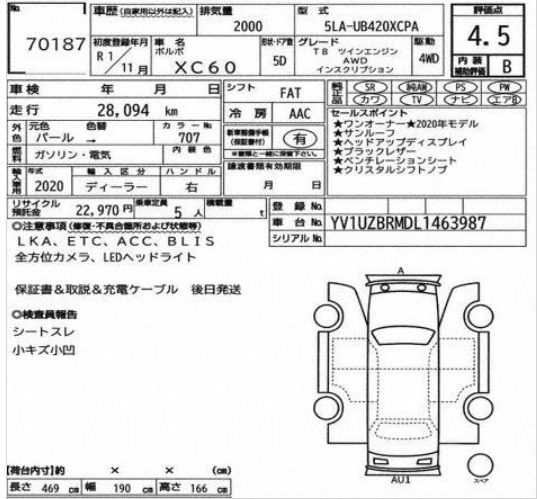
Why Is It Important? Why do you need an Auction Sheet?
The auction sheet serves as your only independent verification of a vehicle’s true condition. Because the inspectors are third-party professionals and not the sellers themselves, the report offers a level of transparency rarely found in private sales.
This document protects you from common pitfalls like mileage rollbacks, hidden accident damage, structural issues, or prior panel replacements.
Furthermore, Japan enforces strict consumer protection laws, and auction houses face severe penalties for false reporting. Without a proper translation, however, you might miss the subtle difference between a “minor scratch” and “frame damage”.
Making that mistake can cost you thousands in repairs later. Understanding these reports is a key step in learning how to avoid import scams.
What Information Is Included on an Auction Sheet? Car grades explained
To effectively learn how to translate a Japanese auction sheet, you must break the document down into its core components.
The table below outlines the essential elements found on most reports:
Element | What It Means | Example |
|---|---|---|
Grade | Overall condition (1–6, S, R, RA) | Grade 4.5 = Very good |
Interior Grade | A–E (A = Like new) | A or B |
Exterior Score | 1–100 or code-based | 85% |
Mileage | Verified kilometers | 45,000 km |
Rust Score | Rust on undercarriage/body | 「R」 = Rust present |
Repair History | Triangle (Δ) = Panel replacement | Δ on front fender |
Auction House | Source of the report | USS Tokyo |
Chassis Number | Unique VIN | NHP10-XXXXXX |
Understanding the Grade Scale Reference
Use this reference table to understand the general hierarchy of auction grades:
Grade | Meaning |
|---|---|
6 | Brand new / delivery mileage |
5 | Exceptional, near showroom condition |
4.5 | Very good, minor wear |
4 | Good, normal used condition |
3.5 | Average, visible wear |
3 | Fair, some repairs needed |
R | Repaired (accident history) |
RA | Repaired with auction sheet annotation |
1–2 | Poor condition, project car |
Using AI to Translate? Why It’s Not Recommended
Many buyers attempt to use ChatGPT or Google Translate, but these tools fail on specific auction terminology. For instance, they cannot interpret symbols like Δ, ○, □, or R marks.
A real-world example is the term 「修復歴あり」; while AI translates this as “repair history exists,” it actually specifically denotes structural accident damage.
Similarly, relying on a Japanese-speaking friend or spouse who isn’t an industry expert can be risky. They may miss subtle red flags, such as 「外装コーティングあり」.
While this literally translates to “exterior coating exists,” in an auction context, it can sometimes imply the car was repainted to hide damage.
To ensure total accuracy, you should always contact TokyoCarZ for translation services. Our team of experts understand every code, symbol, and auction house variation.
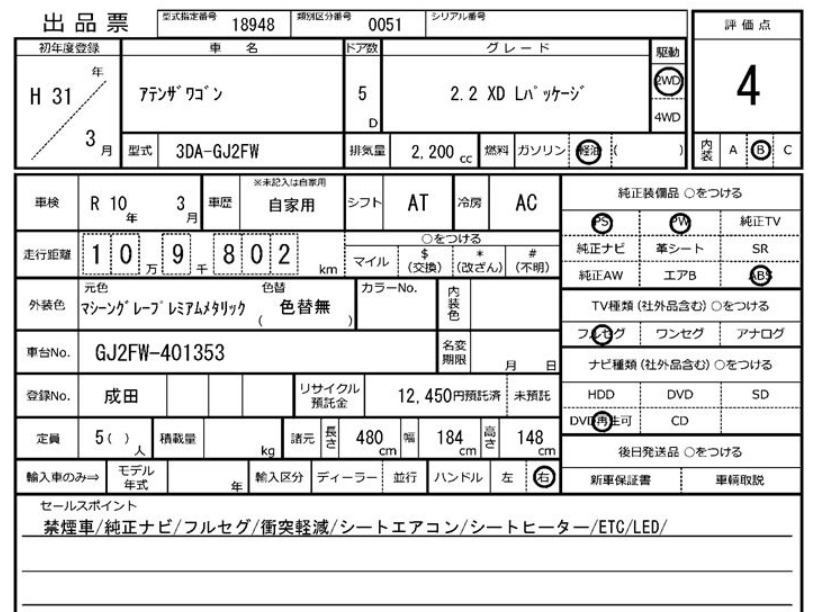
How to Buy from Auctions with TokyoCarZ
Navigating the Japanese auction system is simple when you follow our professional 8-step process:
- Get in touch: Tell us what car you want: Specify the body style (Sedan, SUV, etc.), fuel type (Hybrid, Petrol, etc.), mileage limits, and preferred grade—we usually recommend Grade 4 or higher.
- Pay a commitment fee: This fee is based on the total CIF, shows serious intent, and is either refundable or credited toward your purchase.
- Study car statistics: Review auction sheets, history reports, and choose between live bidding or “one-price” stock options.
- Start bidding: We bid on your behalf up to your pre-determined limit with no surprise fees. You will also have access to the account and keep track of the bidding process throughout.
- Win and clear balance: Once you win, you pay the remaining balance, and we handle all Japanese export documentation.
- Straight to inspection: The vehicle undergoes QISJ or equivalent inspections, including safety and radioactivity checks.
- Shipping: We arrange Ro-Ro or container shipping to Mombasa or your destination port with real-time tracking.
Frequently Asked Questions (FAQs)
1: Can I use Google Translate to read an auction sheet?
Not recommended. AI often misses auction-specific codes, symbols, and context. What translates as “repair history” could mean a minor scratch—or major frame damage.
2: What is the difference between Grade R and Grade RA?
Grade R means the car has a repaired accident history. Grade RA means it was repaired with specific annotations on the auction sheet. Both indicate prior damage and should be avoided by non-experts.
3: How can I spot a fake auction sheet?
Real sheets have watermarks, consistent formatting, and verifiable chassis numbers. Fake sheets often show poor image quality, mismatched fonts, or missing auction house branding.
4: Does TokyoCarZ provide auction sheet translation?
Yes. Our team provides professional, human translation for every vehicle you bid on.
5: Where can I find free, reliable auction sheets online?
Be cautious. Free sheets from unknown sources are often fake or incomplete. We provide verified sheets directly from USS, AUCNET, and TAA.
6: Why is AI or in-house translation risky?
AI cannot interpret nuances or symbols. Even a native Japanese speaker may not understand technical auction terminology like specific rust codes.
7: Can I bid without seeing the auction sheet?
Never. Always demand the original auction sheet. If an exporter refuses to provide it, it is likely a scam.
8: What does a triangle (Δ) on an auction sheet mean?
The triangle (Δ) indicates a panel replacement or body repair. While one might be minor, multiple triangles signify significant accident damage.
9: Are inspectors paid to lie on the reports?
No. Japanese auction houses are strictly regulated. Inspectors are third-party professionals who face severe penalties for false reporting. Their reputation and livelihood depend on accuracy.
No. Japanese auction houses are strictly regulated. Inspectors are third-party professionals who face severe penalties for false reporting. Their reputation and livelihood depend on accuracy.
10: Is it possible that the inspection report does not match the car’s condition?
Yes, there is some risk. Approximately 80% of auction sheets are accurate. Around 10% are worse than the report, and another 10% are better. This is why professional translation and pre-bid inspections are essential.
Yes, there is some risk. Approximately 80% of auction sheets are accurate. Around 10% are worse than the report, and another 10% are better. This is why professional translation and pre-bid inspections are essential.
11: Does an auction grade equal the car’s overall condition?
No. A grade is a filter, not the full story. Grades help sort vehicles by price, condition, and desirability, but they do not provide complete information. Mileage, interior condition, rust, and repair history all contribute to the final assessment.
No. A grade is a filter, not the full story. Grades help sort vehicles by price, condition, and desirability, but they do not provide complete information. Mileage, interior condition, rust, and repair history all contribute to the final assessment.
12: Are there determinants for grades?
Yes. Mileage and interior condition are key factors. For example, approximately 90% of Grade 2 vehicles have rust. Understanding these patterns helps you interpret grades more accurately.
Yes. Mileage and interior condition are key factors. For example, approximately 90% of Grade 2 vehicles have rust. Understanding these patterns helps you interpret grades more accurately.
13: Do different auction houses have different grading systems?
Yes. USS, AUCNET, TAA, and JU each have slightly different scales. A Grade 4 at USS may mean something different from a Grade 4 at another auction house. Additionally, grading systems vary by country. A Japanese Grade 3.5 might be considered “excellent” elsewhere. Always know the source before interpreting the grade.
Yes. USS, AUCNET, TAA, and JU each have slightly different scales. A Grade 4 at USS may mean something different from a Grade 4 at another auction house. Additionally, grading systems vary by country. A Japanese Grade 3.5 might be considered “excellent” elsewhere. Always know the source before interpreting the grade.
